
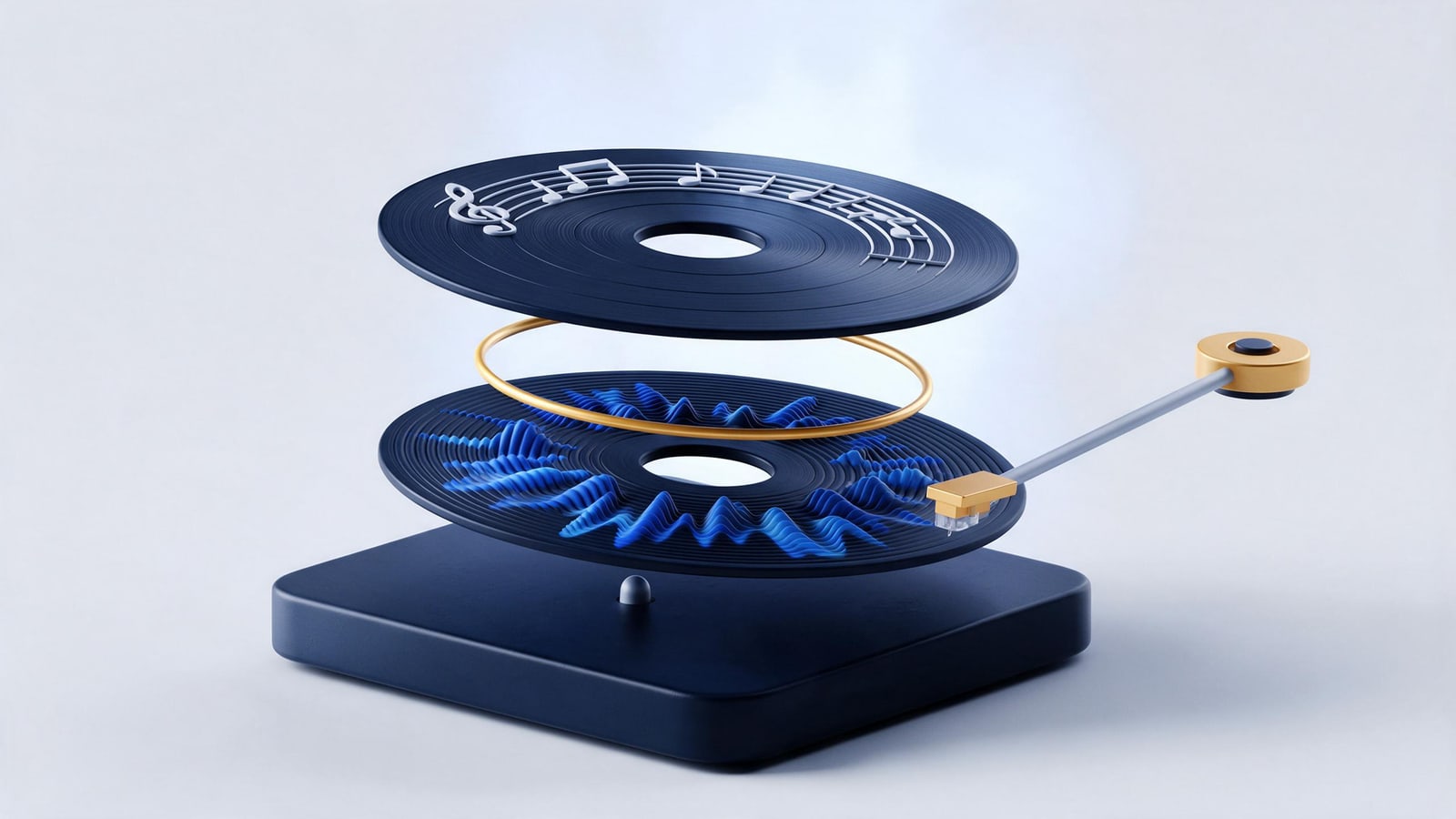
Every recorded song is two separate copyrighted works, usually owned by different people. Video uses need a sync license for the composition plus a master-use license for the specific recording. Reproducing and distributing the song itself, a download, a CD, an interactive stream, needs a mechanical license for the composition. Playing music in public needs a performance license from the PRO that represents the writers.
Pick the wrong column and the consequence is a claim, a muted video, or a strike. Here is how each license works, where the MLC and the PROs sit in the machinery, and how to tell which permission your project requires.
One Song, Two Copyrights: How Music Copyright Law Splits a Track
The composition is the song itself, melody, harmony, lyrics as written. It belongs to the songwriters and, in most cases, their music publisher. The sound recording, called the master, is the fixed studio performance of that song. It belongs to whoever paid for the session, usually a label or the recording artist.
Copyright arrives as a bundle of exclusive rights under 17 U.S.C. § 106: reproduction, distribution, derivative works, and public performance. Every license is permission to exercise one or more of them. A mechanical license covers reproduction of the composition. A performance license covers public performance. A sync license is a negotiated bundle covering the composition inside an audiovisual work. The same rights exist on the master side, licensed separately.
A cover version creates a new master owned by the cover artist, while the composition underneath stays with the original writers. Plenty of confusion traces to assuming the two travel together.
The clocks also run separately. A song published in 1930 entered the US public domain on January 1, 2026, but a 1930 recording of that song remains protected under the separate term schedule Congress gave sound recordings. You can be free to use the song while every historical recording of it is locked. For a full breakdown of how long copyright lasts for each side of the work, we cover that separately.
Sync Licensing and Master-Use Licenses: What Video Uses Must Clear
A synchronization license attaches a composition to moving images. Film, television, advertising, YouTube videos, games, corporate training, wedding films, all of it is sync territory. The license comes from the song's owners: every co-writer, or their publisher. US law provides no compulsory sync right, so two things follow. There is no statutory rate, and there is no obligation to say yes. A publisher can refuse a use it objects to, and often will when a brand is attached.
A master-use license covers the same scope for one specific recording, and it comes from whoever owns that master. Using the famous version requires both licenses. Re-recording the song yourself drops the master-use license, but sync for the composition is still required, the compulsory mechanical license covers phonorecords, never video, and that asymmetry trips up many creators.
Both licenses are negotiated contracts with real deal points: media (internet only, broadcast, theatrical), term, territory, and fee. Independent songs can clear for hundreds to low thousands of dollars for modest online uses. Well-known catalog in national advertising runs far higher. Performance royalties still flow to the writers when synced content airs or streams, generally through the platform's or broadcaster's own PRO licenses.
Royalty-free libraries grant pre-cleared sync and master rights for a fee, a legitimate shortcut for small projects, but scope limits hide in the terms. Many library licenses exclude broadcast and political uses. Read the media and territory grant before buying.
Mechanical Licenses and the MLC: Covering Reproduction and Streaming
A mechanical license is permission to reproduce and distribute the composition in phonorecords: CDs, vinyl, permanent downloads, and interactive streams. Note the direction, it licenses the song, not any particular recording of it.
Section 115 of the Copyright Act makes mechanicals partly compulsory. Once a musical work has been recorded and distributed in the US with the owner's authorization, anyone can license it by following the statute: notice, payment, monthly accounting. The owner cannot refuse. That is why cover songs can be released without the songwriter's blessing, and why the same songwriter can still block that cover from a film.
Rates come from the Copyright Royalty Board, three judges appointed by the Librarian of Congress. Under current rates, physical product and permanent downloads pay 9.1 cents per unit for songs up to five minutes, prorated per minute above that. Interactive streaming pays under percentage-of-revenue formulas that have risen across recent rate periods.
The Music Modernization Act of 2018 rebuilt the digital side. Streaming and download services now take a blanket mechanical license through the Mechanical Licensing Collective, the MLC, a nonprofit designated by the Copyright Office that began collecting in early 2021. Services report usage and pay the MLC, which matches songs to rights holders and distributes monthly. Writers and publishers must register their works and claim their shares to get paid, including from the roughly $424 million in unmatched historical royalties transferred at the outset.
Two limits matter in practice. The blanket license covers digital services only, a label pressing vinyl still clears each mechanical individually, often through an administrator such as the Harry Fox Agency. And the MLC is US-only; mechanicals elsewhere flow through each country's local society. Distributing a cover through a streaming service is generally covered by that service's blanket license. Press the same cover on CD and the clearance is yours to arrange.
PROs and the Public Performance License: ASCAP, BMI, SESAC, and GMR
The public performance right reaches live venues, radio and television broadcasts, stores, restaurants, gyms, and streams. It is licensed in bulk. Four US performance rights organizations, ASCAP, BMI, SESAC, and GMR, sign up songwriters and publishers, then sell blanket performance licenses by business type. A bar may pay ASCAP, BMI, and GMR separately, because the PROs do not share catalogs.
Songwriters get paid when their PRO tracks performances, census reporting for major broadcasters, sampling for smaller venues, and every dollar splits into a writer share and a publisher share. Foreign repertoire is collected through reciprocal agreements with overseas societies.
The sound recording has its own performance layer, and US law handles it unevenly. Under 17 U.S.C. § 114, non-interactive digital services such as webcasters and satellite radio take a statutory license, with SoundExchange collecting and paying under a statutory split: half to the master owner, 45 percent to the featured artist, and 5 percent to funds for session players. AM/FM radio pays no sound-recording performance royalty at all; only the composition side earns there. Most other countries pay performers and labels for radio play through neighboring-rights systems, so a master often earns abroad what it cannot earn at home.
Which Music License Does Your Use Need? The Decision Map
Find your situation at the start of each line; the licenses that follow are what you must clear:
- A commercial recording in your video, film, ad, or game, sync license for the composition plus master-use license for the recording.
- A cover you recorded yourself in that same video, sync license only; there is no compulsory license for video uses.
- An audio-only cover release on streaming, downloads, or vinyl, mechanical license for the composition; the recording is yours.
- Sampling, permission from both the composition owner and the master owner, with no compulsory license to fall back on.
- Background music in a store, bar, gym, or restaurant, performance licenses from the relevant PROs; a live cover band is covered by the venue's PRO license, not by mechanicals.
- A non-interactive internet radio station, PRO licenses for the compositions plus the § 114 statutory license through SoundExchange for the recordings.
- Music during a livestream, the same sync and master rights apply to clips and saved broadcasts, but platform policy determines what actually gets enforced, which is the next section.
- Podcast intro or background music, clearance from both the composition and recording owners, or licensed production music; an episode is a distributed recording, and a mechanical alone does not paper it.
Where Platform Policy Changes the Answer: YouTube, Twitch, and TikTok
The law above is the floor. Platforms build their own licensing on top, and the practical answer is often a platform answer.
YouTube holds performance licenses with the PROs and has negotiated publishing and label agreements for specific uses, which is why some claimed videos stay up with revenue redirected instead of deleted. Most enforcement runs through Content ID: rights holders register fingerprints, matching uploads trigger claims, and disputes play out inside the platform rather than through a DMCA notice. YouTube has also run programs such as Creator Music that sell licenses for parts of the catalog in some markets. None of this makes the catalog free for every use, whether you can use copyrighted music on YouTube lawfully depends on the song, the feature, and the claim policy in force that day.
Twitch spent years without comparable coverage, and it showed. In 2020 a wave of label notices led Twitch to delete a large amount of recorded streams and clips, and the Twitch music DMCA purge that followed is the case study for what happens when platform coverage meets catalog reality. Twitch has since reached licensing and settlement arrangements with parts of the industry, but its licensed catalog for streamers remains narrow. TikTok licenses a commercial music library for personal accounts, while business accounts draw from a smaller commercial-use catalog, a trap that catches brands.
Treat platform permission as a license from some owners for some uses, and re-check policies before relying on them. Policy decides whether you get the strike. The law still decides whether you infringed.
When No License Was Cleared: Infringement, Strikes, and Enforcement
Unlicensed use infringes whichever rights the use implicated. The first consequence is usually a platform claim or a takedown notice under 17 U.S.C. § 512, followed by strikes and repeat-infringer termination. Litigation is rare but real, and a registered work can claim statutory damages, $750 to $30,000 per work, up to $150,000 for willful infringement. Fair use gets cited constantly in comment threads; it is a defense to be litigated, not a license, and whole-song uses in monetized content rarely win it. If a notice has landed on your video, do not ignore it, read what to do when you receive a DMCA notice, because the counter-notice path runs on a strict timeline with real consequences.
Flip the camera and licensing becomes an enforcement map. If you own the composition or the master and find unlicensed use, a proper § 512 notice to the platform is the fastest lever. Registering your works first is what turns ownership into full damages leverage, so understand what copyright registration actually gets you before a dispute starts, not after. Rights holders working at volume will find the filing patterns in our pages on DMCA takedowns for musicians and on stolen music uploaded at scale. What most owners skip is monitoring: music leaks into videos, streams, and storefronts continuously, which is exactly what music protection services are built to catch.
How to Clear a Song Without Guessing
Clearance is a research task followed by a negotiation. Start by identifying both works: who owns the composition, in what shares, and who owns the master. The PRO repertory databases, ASCAP's and BMI's are free to search, list the publishers and shares for a song; the label on the release points to the master owner. Confirm splits before spending money, because a song with four publishers needs four yeses unless one administrator holds exclusive rights to grant them all.
Approach both sides in parallel with one specific sentence describing the use: what the production is, where it will run, for how long, in what territory. Rights desks price scope, not songs, so vague inquiries produce padded quotes. A signed master license is worthless without sync and vice versa, so never paper one side and hope on the other. Keep the signed licenses permanently, platforms and rights holders ask for them years later.
Frequently asked questions
Do I need a sync license for a cover I recorded myself?
Yes, once the cover appears in video. Section 115's compulsory license covers phonorecords, audio-only reproductions and streams, never timed use with visuals. Your own recording means no master-use license is needed, but sync for the composition is fully discretionary, and a publisher can simply decline.
Does a mechanical license let me use a song on YouTube?
No. A mechanical covers reproducing the composition in recordings, downloads, CDs, interactive streams. A YouTube video pairs the song with visuals, which is sync territory, and uses a fixed recording, which is master territory. You need a sync license and a master-use license, and the platform's own agreements do not substitute for them.
What is the MLC, and who gets paid by it?
The Mechanical Licensing Collective is the nonprofit the US Copyright Office designated under the Music Modernization Act to run the blanket mechanical license for downloads and interactive streaming. Digital services pay the MLC; it matches songs to rights holders and distributes monthly. Writers and publishers must register and claim their shares, including from the roughly $424 million in unmatched historical royalties it received in 2021.
Who gets paid when a bar plays my song?
The venue's PRO blanket licenses fund the payment. If you are affiliated, your PRO pays your writer share directly and your publisher its share, based on performance tracking. Foreign performances flow back through reciprocal societies. The master owner earns nothing from US bar play or AM/FM radio, the federal recording performance right targets digital services, not those uses.
How much does a sync license cost?
There is no statutory rate. Every fee is negotiated against the song, the use, the media, the term, and the territory. Independent songs in modest online videos can clear for hundreds to a few thousand dollars. Well-known catalog in national advertising runs far higher, sometimes six figures, and some songs are held back from licensing entirely.
What to Do Next
- Write your use down in one sentence: the production or release, the platforms or formats, the duration, the territory. Every rights desk will ask for exactly this.
- Search the ASCAP and BMI repertories to identify the composition owners and their splits; identify the master owner from the release.
- Request sync and master-use quotes, or a mechanical, for audio-only releases, in writing, in parallel, with that sentence attached.
- If you own the music, register the works, claim your catalog with the MLC, affiliate with a PRO, and put monitoring in place.
- If your music is already being used without a license, in videos, streams, storefronts, or full-song uploads, get professional help. ProtectionPro combines detection, managed takedowns, and ongoing enforcement for rights holders, and WebDMCA's team files music takedowns every day.