
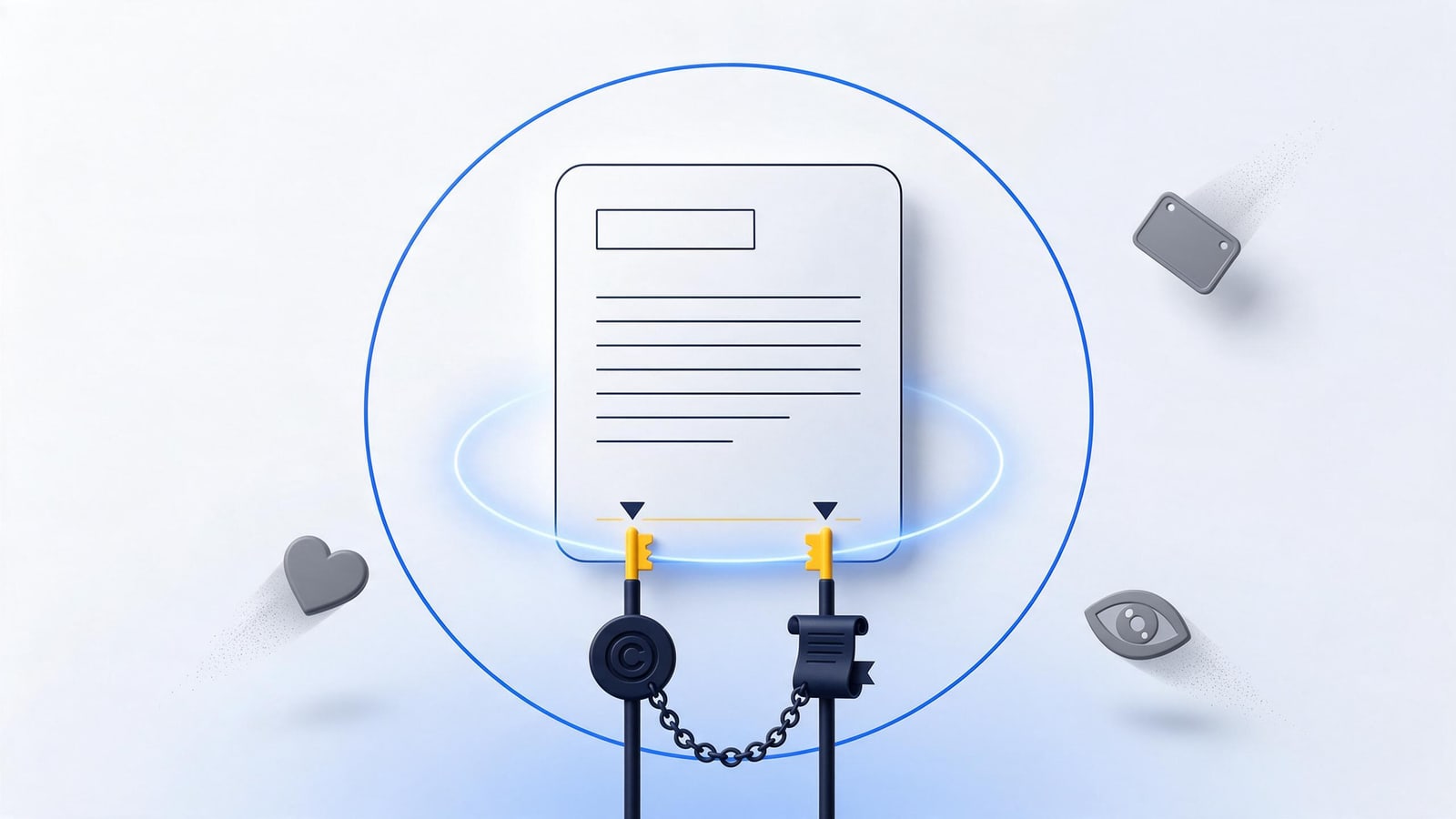
US law recognizes exactly two groups who can file a DMCA takedown: the owner of an exclusive right in the work, and anyone that owner authorizes to act for them. Every valid notice closes with a sworn statement, under penalty of perjury, that the sender belongs to one of the two. That sentence, drawn from 17 U.S.C. § 512(c)(3)(A)(vi), is the standing test in miniature.
The circle is wider than most people assume: you need not be a lawyer, an American, or even the creator. But it is not everyone, and a notice sent from outside the circle is not a harmless formality, § 512(f) makes false claims of authority expensive. Here is how to tell which side of the line you are on.
The sworn statement that decides DMCA standing
Section 512(c)(3) prescribes six elements for a compliant notice: a signature, identification of the copyrighted work, identification of the infringing material with enough detail for the provider to locate it, contact information, a good-faith statement that the use is unauthorized, and the closing sworn statement. Read the closing element closely. The penalty-of-perjury language attaches to the authority claim, not to the accuracy claim: you swear, under perjury, that you are authorized to act for the owner of an exclusive right that is allegedly infringed. The accuracy sentence is not itself sworn, though lying in it still triggers § 512(f), and our annotated notice template breaks all six elements down.
A hosting provider removes content on the say-so of a complete stranger because ignoring a compliant notice risks its safe harbor immunity for infringement claims tied to that material. Nobody screens your authority at the door; notices run on declarations, checked after the fact. The notice works whether or not you told the truth, the truth is what you answer for later.
Group one: the copyright owner
Ownership is the first path. Section 106 gives owners a bundle of exclusive rights, reproduction, distribution, public performance, public display, derivative works. Whoever holds even one can enforce it, and the default owner is the creator. The exceptions are where people trip.
Work made for hire. When an employee creates something within the scope of employment, the employer is the author from the first keystroke, and the employer files. A freelancer sits opposite: they own the work unless the contract assigns it, and commissioned works qualify as made for hire only in a few narrow statutory categories, each requiring a signed writing.
Assignments must be written. No transfer of exclusive rights is valid without a signed writing under § 204(a), which cuts both ways: a publisher with an exclusive license can produce its paper, and a handshake exclusive license is legally no license at all.
Exclusive licensees count as owners of the right they hold. Grant someone the exclusive right to distribute your book in North America and they can send takedowns over distribution, for that right, they stand in your shoes. A non-exclusive licensee, one of fifty buyers of the same stock license, cannot: they paid for use, not enforcement.
One modern wrinkle: the Copyright Office treats human authorship as a requirement, and purely machine-generated material is not protectable. No owner means no one with standing to file, who owns AI-assisted work is a question with sharp edges.
None of this requires a registration certificate; ownership vests when the work is fixed. But if the poster pushes back, you may need to show the work is yours, and proving content ownership is its own discipline.
Group two: anyone the owner authorizes
Section 512(c)(3)(A)(vi) requires authorization, not credentials. The statute never says "lawyer." Any of these signatures is valid when the owner actually stands behind it: attorneys, in-house staff, managers and talent agents, publishers acting for their authors, professional takedown services, and family members, business partners, or virtual assistants whom the owner asked to handle the problem.
Authorization is the owner saying, in substance: I own this work, and I want this person to enforce it. It can live in an email, a management contract, an engagement letter, or a platform's agency workflow. Nothing needs to be notarized, the sworn statement asserts the authority, and nobody stamps it first. What matters is that it is true, because you are swearing to it under penalty of perjury.
Scope matters more than form. A manager authorized to police YouTube for a musician is not automatically authorized to sue, to license, or to police every other platform. If a takedown campaign escalates into litigation, the named plaintiff usually has to be the owner. For hiring outside help, our guide to choosing a DMCA takedown service covers what a competent one will ask you for, and it should ask.
How to document authorization before you file
Nothing requires proof of authority to accompany the notice. The exposure comes later, when the provider asks, the poster disputes, or a court gets involved, so treat the paperwork as cheap insurance bought now.
A usable written authorization can be a single email, and it should cover four things: who owns the work, who may act, what they may do, which works, which platforms, for how long, and that the owner stands behind the sworn statements made in their name. If you file for others regularly, keep a one-page mandate per client and refresh it when the roster changes. You may never be asked for it; the day you are, an awkward question becomes a two-minute reply. Our agency filing playbook covers the workflow in detail.
One nuance that surprises agents: authorization can be withdrawn. An owner who revokes mid-campaign strands every notice the agent sends afterward on the perjury line, check the mandate still stands before each filing wave.
Your citizenship and location are irrelevant
The DMCA governs the conduct of US service providers. It says nothing about the sender's nationality, residence, or location. A novelist in Nairobi whose book sits on a US-hosted piracy site files exactly the notice a novelist in Nebraska would, because the question is where the content lives, not where the owner does. Foreign works are protected in the United States under international treaties, the Berne Convention foremost, with no US formalities to complete first.
Two caveats. If the host itself is outside the United States, US law may not bind it; how the DMCA behaves across borders is a mixed picture, and many foreign providers honor notices as policy rather than legal duty. Other countries run different systems: Canada's notice-and-notice regime requires providers to forward your notice but not to remove anything, and the EU's Digital Services Act accepts illegal-content reports from anyone. Know which system your target host answers to.
Who cannot file a DMCA takedown
Fans and bystanders. Finding your favorite artist's work on a pirate site is a good instinct with no legal channel attached. Without rights or authorization you cannot file; the professional move is to send the link to the rights holder and let them enforce. The copyright channel on most platforms asks the submitter to confirm rights-holder or agent status, never about a bar number, and lying in that checkbox borrows standing you do not have.
Enforcers on principle. Being offended that a piracy site exists is not standing. A DMCA notice is a tool for a specific owner complaining about a specific work; general indignation has no place to attach. A non-exclusive licensee is in the same spot: a stock subscription lets you use an image, not police it, because fifty other buyers hold the identical license. Enforcement belongs to the owner, or to an exclusive licensee if one exists.
Wrong subject matter entirely. Facts, ideas, methods, and short names sit outside copyright; § 102(b) says so explicitly. Brand confusion belongs to trademark law. Someone impersonating you runs through the platform's identity channels, not its copyright form, see impersonation account removal. Intimate images posted without consent have dedicated routes: see intimate image removal, with one copyright footnote: if you took the photos yourself, you are the owner and a DMCA notice is a legitimate second lever; if someone else took them, those routes are the whole toolkit.
Filing without standing: the § 512(f) problem
Section 512(f) makes anyone who knowingly materially misrepresents, in a notice or in a counter-notice, liable for the resulting damages, plus costs and attorney's fees. A false authority claim is the canonical case: the sworn statement is false the moment you sign it, and good intentions do not launder it.
In Rossi v. MPAA, the Ninth Circuit read § 512(f) to require subjective bad faith: a plain sender who turns out to be wrong is not automatically on the hook. That protects mistakes, not inventions. A fan who signs as an agent was not mistaken about authority; they were making it up. Senders asserting rights they could not possibly hold fare no better, in Online Policy Group v. Diebold, a company sent takedown demands over its own leaked internal emails, a court found knowing misrepresentation, and the company paid the recipients' fees and costs.
Owners overreach too. Notices sent against content that is plainly fair use, or against works you merely wish you controlled, carry the same exposure, see when not to file a DMCA notice, and the wider penalty picture in copyright infringement penalties. If you genuinely cannot tell whether your situation qualifies as ownership or authorization, an hour with a copyright lawyer before the notice goes out is cheaper than the reply that comes back.
Frequently asked questions
Do I need to register my copyright before filing a DMCA takedown?
No. Standing comes from ownership, which exists from the moment the work is fixed. Registration matters at the next stage: you cannot sue over a US work in federal court without it, and timely registration makes statutory damages and fees available. For the notice itself, where registration actually pays off is a separate question from standing.
Can I file a DMCA notice for a friend or family member without asking them?
No. Authorization must come from the owner, and silence is not authorization. Spouses and siblings get no special treatment: the sworn statement is false unless the owner actually authorized the filing. The fix costs five minutes, ask, then keep the answer in an email. If they decline, respect it; the work is theirs.
Can one co-owner file without the others joining in?
Yes. Joint authors each hold an undivided share of every exclusive right, so either can send a valid notice covering the entire work. The limits come later: one co-owner cannot grant an exclusive license without the others, and an infringement suit generally requires all co-owners as plaintiffs. For the takedown itself, one signature is enough.
Can an heir or an estate file for a deceased creator?
Yes. Copyright is property; it passes by will or intestacy like any other asset. Executors, estates, and heirs step into the owner's position and can file themselves or authorize someone else to. The proof changes, probate records replace the creator's original files, but the two-group rule survives intact.
Can a minor file a DMCA takedown notice?
The Copyright Act sets no minimum age, and a minor can own copyright, a young creator's work is protected like anyone else's. But a DMCA notice is a sworn legal statement that platforms expect to be binding, so in practice a parent, guardian, or authorized adult files on the minor's behalf, with ownership documented.
Next steps
- Confirm which group you are in. Owner, exclusive licensee, or authorized agent, if you are none of the three, do not send anything yet. Get written authorization from the owner, or route the link to whoever owns the work.
- Gather your proof. Original files, publication records, registration certificate if you have one. You will not attach them to the notice, but you may need them an hour after sending it.
- Prepare the notice with all six elements. The full mechanics, where to send it and how to word it, take about an hour the first time.
- Or delegate the whole thing. Our managed takedown service folds the authorization paperwork, the filing, and the follow-through into one engagement; current pricing is on the service page.