
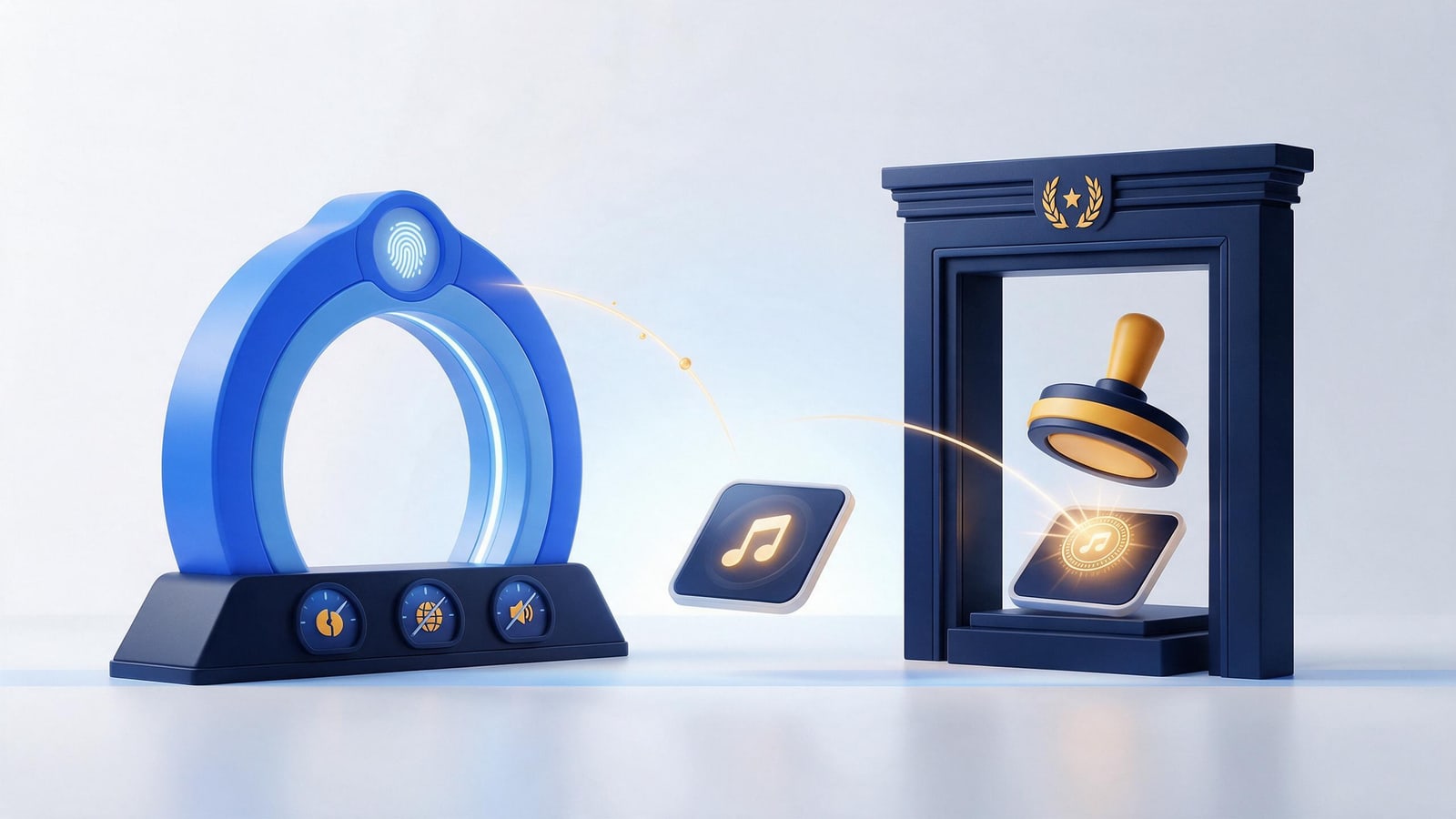
Can I use copyrighted music on YouTube? Yes, the upload button doesn't check. Anyone can publish a video with any track, and nothing on the upload screen stops them. What you don't control is what happens next: the rights holder can claim your ad revenue, mute your audio, block the video in some countries or everywhere, or, rarely, but really, remove the video and put a strike on your channel.
Which outcome you get depends on which of YouTube's two enforcement systems catches the music. Content ID is automated matching; a claim hits monetization and visibility and is not a legal strike. A DMCA takedown is a legal notice from the rights holder: video removed, strike attached, and three strikes terminate the channel. Crediting the artist, disclaimers, and owning a copy of the song change nothing.
How YouTube catches copyrighted music: the two systems
Every upload passes through two enforcement layers with almost nothing in common.
The first is Content ID, YouTube's automated matching system. Labels, publishers, and distributors submit reference files; every upload is fingerprinted against them; a match fires whatever policy the rights holder set in advance. Content ID is platform machinery, not law, nothing in the Copyright Act requires it. YouTube built it in the years after Viacom's billion-dollar 2007 lawsuit against YouTube, which settled in 2014, made clear that waiting for individual takedown notices would never scale. That history is why a machine can claim your video minutes after publishing. A full breakdown of how Content ID works lives elsewhere on this site.
The second is the DMCA takedown: a formal legal notice under 17 U.S.C. § 512(c) sent by the rights holder or their agent. No automation, no pre-set policy, a person decided your video was worth removing, and the video comes down with a strike attached to the channel.
What a Content ID claim actually does to your video
A match triggers one of four pre-set policies:
- Monetize, ads run on your video and the revenue goes to the claimant. Some rights holders share that revenue; most simply take it.
- Track, the video stays up, you keep everything, the claimant watches the analytics.
- Block, the video becomes unviewable worldwide or in the countries the claimant selected.
- Mute, the matched segment plays in silence.
None of that is a copyright strike. Your channel is not penalized; you've lost control of one video's revenue or reach. That's why so many videos with commercial music stay up for years, the label earns more from your ads than it would from removing the video. If you never monetize, a claim can feel invisible: ads you didn't choose appear, or your analytics quietly list countries your video will never reach.
Two planning details. Regional blocking is the claimant's policy executed by the platform, not a court order. And the DMCA itself is US law, how takedowns work outside the US depends on each country's regime, which is why a video can vanish in Germany while staying live in Brazil.
What a copyright strike actually costs
A rights holder can skip automation and send a DMCA takedown at any time, the same legal document covered in our walkthrough of the YouTube DMCA takedown process. The video is removed, a strike lands on the channel, and you're routed into Copyright School before uploading normally again.
Strikes expire after 90 days if you complete the course. Collect three live strikes and YouTube terminates the channel, its videos, and related channels it links to the same operator. That rule isn't platform whim: safe harbor under 17 U.S.C. § 512(i) requires providers to adopt and reasonably implement a repeat-infringer policy, which is why platforms terminate repeat infringers at all. We cover what a DMCA strike actually is in depth elsewhere; the stakes are the point here. A claim costs one video's revenue. A strike suspends uploads for 90 days. Three end the channel.
A strike is not a lawsuit, but nothing stops a rights holder from going to court instead, where statutory damages under 17 U.S.C. § 504(c) reach $150,000 per willfully infringed work. Suits against small creators over background music are rare. Copyright infringement penalties beyond the platform are the tail risk that makes "the label will just claim it" a gamble rather than a strategy.
The myths that lose channels
All of these fail the same way: they describe your intent, and copyright doesn't run on intent.
- "I'll credit the artist." Attribution is not a license. The rights holder never agreed to your use, and the credit in your description mostly documents that you knew exactly whose song you took.
- "No copyright infringement intended." A disclaimer announcing you're using something you suspect you shouldn't. Zero legal effect, and if a human ever reviews, it reads as awareness, not innocence.
- "I bought the song." A purchase licenses personal listening, not synchronization into a public video. Different right, different price.
- "It's under 15 seconds." No safe duration exists in US law. Amount used is one factor in a fair-use analysis, not a threshold, short clips get claimed and struck constantly.
- "I'll pitch-shift it." Matching systems are built to survive pitch and tempo changes; that's the core of how content fingerprinting works. Evasion also looks worse if a person ever reviews the file.
- "It's just a cover." Covers need licenses too, the composition is a separate copyright from the recording, and blanket platform agreements cover some publishers, not all. Claims on covers are routine.
- "The song is decades old." Most commercial recordings are still protected. How long copyright lasts in the US runs decades past release, and 1950s hits are claimed on YouTube today.
When fair use is a real defense
Fair use, codified at 17 U.S.C. § 107, covers commentary, criticism, review, parody, and teaching. The pattern that holds up: the music is what your video is about. A critic dissecting a track's production, a video essay arguing a score defined a genre, a parody that targets the original, each serves a purpose the original did not.
The Supreme Court sharpened the first factor in 2023 with Warhol v. Goldsmith: when a use serves the same purpose as the original work, it weighs against fair use even if the new work looks different. That kills the common cases. Background music for a vlog, a workout mix, a compilation playing the tracks in full, all serve the original's exact purpose, entertaining an audience with that music. The four factors are unpacked in our fair use guide; the shortcut is asking whether your video is about the music or merely accompanied by it. "I needed a vibe" scores zero.
Fair use also isn't a shield against claims. Content ID doesn't evaluate fair use, it matches fingerprints. A bulletproof video essay still gets claimed, the dispute clock runs weeks, and the appeal path ends with the claimant either releasing the claim or filing a real DMCA takedown. If your format depends on critique, build the delay into your publishing schedule.
How to respond to a claim or a strike
A Content ID claim you have a case against: dispute inside YouTube Studio with specifics, "licensed via [service], license number X," or "this video is commentary on the track itself, fair use." Generic disputes lose. The claimant has 30 days to respond, and silence often releases the claim. If they uphold it, you can appeal, and the appeal forces their hand: release the claim or convert it into a formal DMCA takedown.
A claim you can't fight: use the built-in editor. Studio can trim the claimed segment, mute it, or swap in licensed audio while keeping your views and watch time. Usually the smart move; a weak dispute burns weeks and irritates a claimant you may meet again.
A strike that is genuinely wrong: the instrument is a counter-notification under 17 U.S.C. § 512(g), your sworn statement that the removal was a mistake. It hands your name and contact details to the claimant, and a knowing misstatement creates liability under § 512(f). Once filed, the claimant has 10 to 14 business days to sue; otherwise the video returns and the strike clears. Read what happens after a counter-notice before filing anything.
A strike that is deserved: take it. Complete Copyright School, stay clean for 90 days, and change how you source music so there's no second one.
Music you can use without the gamble
The boring options, in rough order of effort:
- YouTube Audio Library, free tracks and effects cleared for the platform. Some require attribution in your description; give it.
- Creator Music, YouTube's in-Studio marketplace, where available, lets you license commercial tracks before publishing or share revenue with the rights holder, terms visible up front.
- Creator subscriptions, Epidemic Sound, Artlist, and Musicbed sell blanket licenses. Read what you bought: personal tiers often exclude client work and paid ads, and a monetized channel is not the same as commercial use.
- Royalty-free and Creative Commons catalogs, the license is the whole product. Some CC tracks ban commercial use; some free downloads require credit. Royalty-free means no per-use royalties, not no owner.
- Direct licenses, for a commercial track you can't replace, you need a synchronization license from the publisher and a master use license from the label. The split behind sync and mechanical licensing is why this takes real paperwork and real money. Worth it for flagship content only.
The flip side: when your music is in someone else's video
The same two systems work for you here. Content ID, delivered through your distributor, monetizes and tracks uses automatically. For videos that matter, reuploads, compilations, unauthorized remixes, takedowns are the tool, and volume is the usual problem: one track spreads across YouTube, TikTok, and file lockers faster than you can file. DMCA from the musician's side, including the two-rights problem that lets a single video infringe your composition and your recording separately, is covered elsewhere. When your catalog is scattered across more platforms than you can chase individually, our managed takedown service consolidates it into one case.
Frequently asked questions about copyrighted music on YouTube
Will Content ID catch even a few seconds of a song?
Usually. Matching runs on fingerprints, not durations, and the sensitivity threshold isn't published. Short, quiet, background segments get claimed regularly, creators discover faint songs playing from a car radio in their footage. The absence of a claim on someone else's video proves nothing about yours; policies differ per rights holder, and enforcement is inconsistent by design. Treat any recognizable use of a commercial track as claimable.
Can I use copyrighted music if my channel isn't monetized?
Monetization is irrelevant to copyright. The claimant's policy applies whether or not you run ads: a monetize policy redirects revenue to them, while block and mute cost you reach with no money involved. "They can have the revenue" is the claimant's choice to permit, not a right you hold. Non-monetized videos get muted and blocked every day.
Does a Content ID claim damage my channel?
No. A claim attaches to one video and affects only that video's revenue or availability. It is not a copyright strike, it doesn't count toward the three-strike threshold, and YouTube treats the video as policy-compliant, the claimant just controls part of it. Disputing doesn't prejudice your channel either. Plenty of healthy channels carry claims on individual videos for years.
What happens if I dispute a claim and lose?
The claim stays, and the video stays monetized for the claimant or blocked as before. Losing a dispute doesn't add a strike by itself. You get one more step, an appeal, but the appeal has teeth: the claimant must either release the claim or file a formal DMCA takedown, which removes the video and adds a strike you'd then fight by counter-notification. Appeal only when you're certain.
Do the same rules apply to Shorts and livestreams?
Yes. Shorts run through the same matching, the music picker inside the Shorts editor is pre-cleared, but tracks you import yourself are not. Livestreams carry more risk: matching runs in real time, copyright issues can interrupt or end a stream mid-broadcast, and the archived replay stays claimable. Performing others' songs live is its own licensing problem, and music-focused streams get struck regularly.
What to do today
Regardless of where this finds you, the order of operations is the same:
- Check the copyright column on every video in YouTube Studio, claims sit there quietly for months.
- Replace unlicensed commercial tracks with Audio Library or subscription music, and file every license confirmation where you can find it again.
- If you hold a license or a real fair-use case, dispute today, with specifics, the 30-day clock runs on their side.
- If a strike is genuinely wrong, read the counter-notice timeline before filing anything.
- If the problem runs the other way, start with your distributor's Content ID and escalate to takedowns for what automation can't reach.