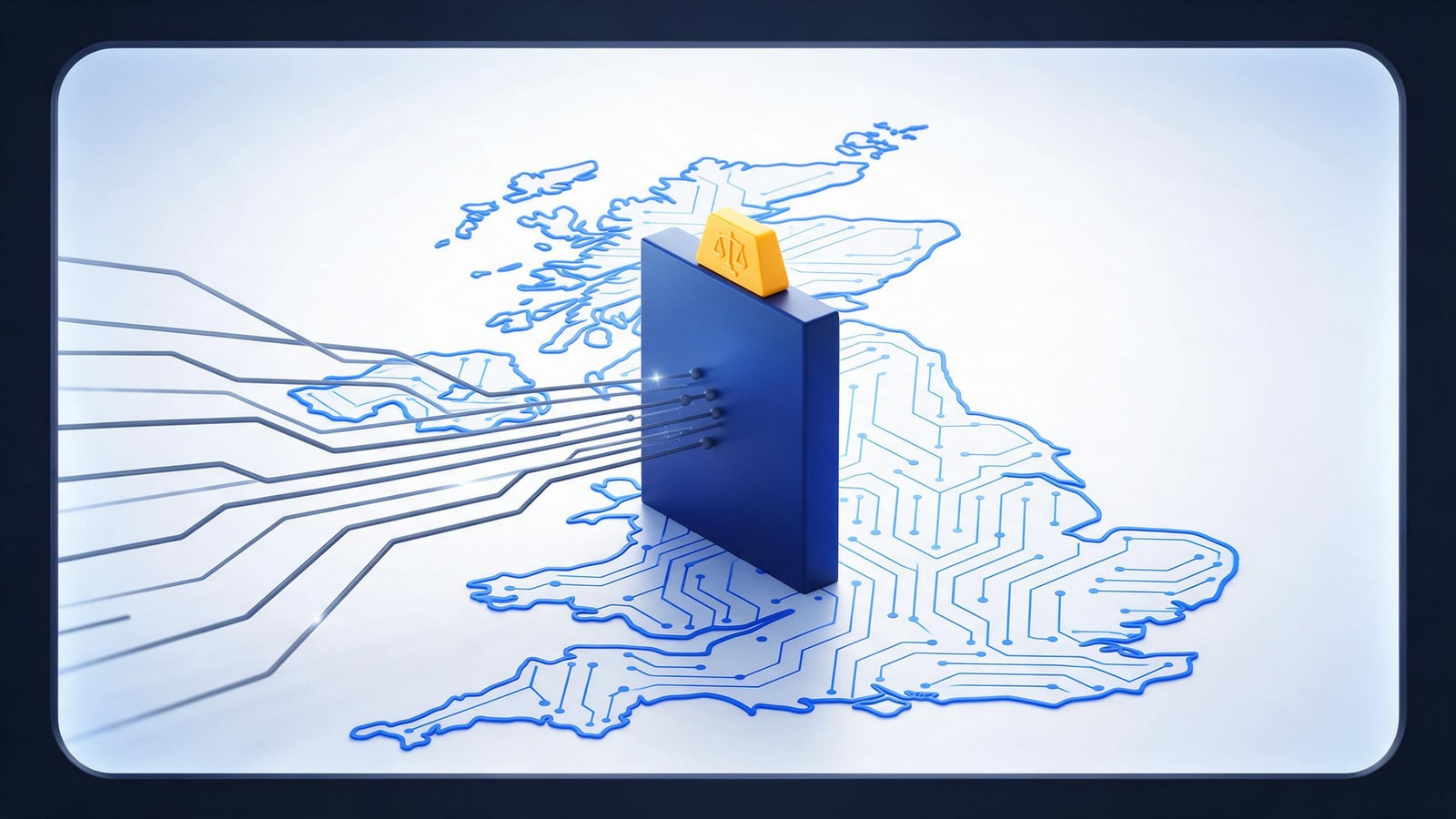
Britain has no DMCA. UK copyright lives in the Copyright, Designs and Patents Act 1988 (CDPA), which contains no statutory notice-and-takedown scheme comparable to the one US hosts operate under Section 512. Removal still happens here, constantly. It just runs through different doors: the host's own terms of service, the CDPA's hosting rules, court-ordered site blocking, the Online Safety Act 2023, and Nominet's dispute service for .uk domains. Our guidance on this site defaults to US law, so every point below where UK practice drives the outcome is flagged as such. If the distinction is new to you, start with how copyright and the DMCA differ, then read up on whether the DMCA works internationally.
The short answer: a clear, well-evidenced infringement notice sent to the right recipient gets most UK hosts to remove content. Not because a statute compels action on a fixed clock, it doesn't, but because keeping material online after the host gains actual knowledge destroys the legal defense that shields it. This article walks each route in working order: CDPA basics for hosts, the section 97A blocking lineage, the notice itself, the Online Safety Act route for intimate images, and Nominet's .uk process.
UK copyright basics for hosts: what the CDPA gives you
Copyright arises automatically in the UK the moment an original work is created. There is no register, no deposit, and no copyright office, the UK has never had one. Section 16 of the CDPA reserves the exclusive rights: copying, issuing copies to the public, renting or lending, performing or playing in public, communicating to the public, and making adaptations. For most works, protection runs for the author's life plus seventy years. If you created it and someone copied it without permission, you already own every right you need.
Hosts stand in a different position from uploaders. The Electronic Commerce (EC Directive) Regulations 2002, retained UK law after Brexit, give a hosting provider a defense to infringement claims over user-posted content while it lacks actual knowledge of the illegality, provided it acts "expeditiously" to remove or disable the material once it has that knowledge. That single clause is the lever behind every UK takedown notice. It differs from the US safe harbor regime in one key way: the American system creates a formal procedure with designated agents, statutory notices, and counter-notices. The UK rules create a shield without a procedure. There is no agent directory and no statutory form.
Two consequences follow. Your notice does not trigger a legal duty; it strips the host of its defense, which is close enough that most hosts act. And hosts process reports under their own acceptable use policies, at their own speed. Most UK hosts run DMCA-style abuse desks anyway, partly because their suppliers, data centers, CDNs, payment processors, sit in the US, where the real DMCA applies. Post-Brexit, UK hosts also sit outside the EU's notice-and-action system, so don't expect DSA reporting routes to help you here.
Section 97A blocking injunctions: from Newzbin to live football
Section 97A CDPA, inserted in 2003 by regulations implementing the EU Information Society Directive, gives the High Court power to grant an injunction against a service provider that knows its service is being used to infringe copyright, or is aware of facts from which that is apparent. UK courts have used it to build one of the most developed site-blocking regimes anywhere.
The lineage matters if you're weighing court action. In 2011, in the Newzbin2 litigation, the High Court ordered BT to block a pirate Usenet indexing site, the first such order. In 2012 the court granted orders against the major ISPs over The Pirate Bay in Dramatico v Sky, and the Court of Appeal upheld the approach the same year. In 2013, EMI v Sky extended blocking to torrent sites including Kickass Torrents. In 2017 the Premier League obtained the first live order, blocking match-day server URLs as they changed during games, a technique rights holders have since used season after season in live sports blocking.
The Supreme Court confirmed in 2018, in a trade-mark case involving Cartier, that rights holders rather than ISPs bear the implementation costs of blocking. Expect the same economics in copyright orders.
The practical read: section 97A is a remedy against mass-infringement sites at scale. It takes evidence, proportionality analysis, a court order, months, and real money. Nobody uses it to remove one infringing blog post, and you shouldn't either. For single pages and small sites, the routes below are faster by an order of magnitude. We go deeper on how site blocking orders work elsewhere.
Find where the site actually lives before you write anything
A .co.uk address tells you almost nothing about hosting. A British domain on a US server behind a Cloudflare proxy is a completely normal combination. Run the basic checks before writing: WHOIS for the registrar and name servers, a reverse-IP lookup on the resolved address, a look at the response headers. Our guides on how to find out who hosts a website and identifying who owns a domain walk through the steps, and the website detective tool automates the digging.
The answer changes your strategy. If the origin server sits in the US, or behind a US CDN, the DMCA applies directly, and a standard Section 512 notice to the actual host is your fastest route. Reporting through Cloudflare also works: it forwards copyright complaints to the hosting provider and the site owner, which often surfaces the real host for you.
If the site genuinely sits on UK infrastructure, note three contacts: the hosting provider's abuse desk, the registrar of record, and any upstream provider visible in the lookup. The abuse desk is your first stop, and UK abuse desks respond well to reports that quote the host's own terms of service back at them.
How to write a UK takedown notice a host will act on
UK hosts act on reports that read like a professional infringement claim, not a vented complaint. A standard DMCA notice template works as the starting format, it is the lingua franca of abuse desks worldwide, with UK adjustments.
Include, in this order:
- Who you are and your authority: owner or authorized agent.
- The work: title, author, date of first publication, and where it's lawfully published.
- Proof of ownership: dated copies, drafts, camera originals, platform archives. Timestamped evidence does the work registration would do elsewhere, because there is no UK register to point to.
- The infringing material: each exact URL on its own line, with a one-line description.
- The claim in plain words: "This page republishes my article in full without a license."
- A statement of good faith and accuracy, signed, electronic signatures are fine.
- The demand with a deadline: five business days is a common ask.
- Contact details and your preferred reply channel.
Then route it correctly. Send to the host's abuse@ address, not the site owner's sales inbox. Quote the host's acceptable use policy, which almost certainly prohibits infringement. Then quote the 2002 Regulations: a hosting provider must act expeditiously once it has actual knowledge of infringing material. That word, expeditiously, is the pressure point of the entire UK notice.
Two cautions. Claim only what you actually own; overclaiming destroys your credibility with the desk and can expose you to claims for the losses you cause. And remember that the UK's fair dealing exceptions (research and private study, quotation, criticism and review, news reporting, parody) are narrower than US fair use, so confirm the use isn't lawful before you send.
When the host says no: escalation, costs and timelines
Rejection or silence is common and rarely the end. Work up the chain. Registrars can act against rogue sites, and Nominet is a special case for .uk names, covered below. Upstream data centers often have more leverage than the retail host. Every step should be mirrored in search: a Google removal request delists the infringing URLs even while the page survives, cutting most of its traffic. If the infringer monetizes through ads or subscriptions, ad networks and payment processors take infringement reports too.
Court remains available. The small claims track of the Intellectual Property and Enterprise Court hears modest UK copyright claims, with costs recovery deliberately capped. Treat it as a later rung, not a first move. We cover the full copyright removal escalation ladder separately, along with what to do when a takedown gets rejected. One UK-specific note: there is no direct equivalent of 512(f), the US statute penalizing knowingly false notices. Don't read that as license. Bad notices can still generate liability under UK law, and they burn goodwill you'll want on the next round.
Set expectations on time and money. A host notice is free and usually gets an answer in days to a couple of weeks; there is no statutory clock, and the general patterns of how long takedowns take hold here, with UK hosts typically slower than the big US platforms' 72-hour habits. Nominet's process takes weeks per stage. Blocking injunctions take months and serious funding. Before choosing between doing this yourself and hiring help, our breakdown of what takedowns cost applies to UK work too.
Intimate images: the Online Safety Act 2023 route
Copyright is the wrong frame for one category: intimate images shared without consent. The UK handles that under the Online Safety Act 2023, and this is UK law driving the outcome regardless of where the platform sits.
The Act applies to user-to-user services and search services with a significant number of UK users, wherever in the world they operate. Ofcom enforces it, and the illegal-content duties took effect in March 2025. Among the priority offenses are sharing or threatening to share an intimate image without consent, including altered and manipulated images, and cyberflashing. Services must provide accessible reporting routes and act on reports, with penalties running up to £18 million or ten percent of qualifying worldwide revenue, whichever is greater.
For a victim, the sequence is: report inside the platform, citing illegal content under the Act. If the platform fails to act, complain to Ofcom, its complaints function is a real enforcement signal. Report to the police as well; sharing such images has been a criminal offense in England and Wales since 2015, and the 2023 Act broadened the offenses to cover threats and manipulated images. Specialist nonconsensual image removal and deepfake removal help exists because these cases combine legal, platform, and emotional pressures that a copyright notice doesn't touch.
Keep the dual track in mind. If the leaked material is also your creative work, a paywalled photoshoot, for instance, copyright gives you a second, independent claim, and you can run both. The US has since passed the Take It Down Act, which imposes a 48-hour removal duty on covered platforms for nonconsensual intimate images, including AI-generated fakes. That is US law: useful when the platform has US obligations, no substitute for the Ofcom route.
Nominet's .uk dispute process: the DRS
Sometimes the problem isn't the page; it's the domain. Nominet runs the .uk registry, including .co.uk, and its Dispute Resolution Service is the venue when someone has registered a .uk name to exploit yours.
The test has two parts. You show rights in a name, registered or unregistered trade mark rights, or rights in a name used in trade. Then you show the registration is abusive: taken or used to take unfair advantage of your rights, or to cause detriment to them. Squatting on your brand in order to sell it back is the classic case.
The process is faster and cheaper than court. Complaints start with free mediation. If mediation fails, an independent expert decides the case for a fee, with an appeal available. Remedies are transfer, cancellation, or suspension of the domain.
Two limits matter. The DRS is not a copyright forum: the experts decide domain names, not copied content, so the host route handles stolen articles or images, though you can run both in parallel when a squatter has also cloned your site. And it covers .uk only; a .com copycat goes through the UDRP process instead. Separately, Nominet operates a police-request suspension process for .uk domains, which UK police units have used against criminal piracy and counterfeiting sites.
UK copyright takedown notices: common questions
Can I send a DMCA takedown notice to a UK website?
Yes, and it often works, but no UK statute requires the host to process it in DMCA form. Most UK hosts accept the format through their abuse desks because their terms forbid infringement and their US-based suppliers demand it. For the best result, frame it as a copyright infringement report under UK law, citing the CDPA and the hosting regulations rather than a pure Section 512 notice.
Do I need to register copyright before sending a UK takedown notice?
No. The UK has no copyright register; rights exist from the moment of creation. What matters is proof: dated copies, drafts, camera files, publication records. If your work originates in the US or you may litigate there, US registration carries separate advantages, but a UK notice needs evidence, not a certificate.
How fast must a UK host remove content once it receives my notice?
There is no statutory deadline. The hosting defense under the 2002 Regulations requires the provider to act expeditiously once it has actual knowledge, which in practice means days rather than months. Quote that standard in your notice, set a specific deadline, and follow up in writing when it passes.
Can a section 97A injunction block a single infringing page?
Not in practice, and it was never built for that. Section 97A orders target mass-infringement sites, torrent portals, streaming sites, live sports streams, and require scale evidence, proportionality analysis, and a court order with real cost attached. For a single page, the host notice and escalation routes are faster by an order of magnitude.
Does the Online Safety Act 2023 apply to platforms hosted outside the UK?
Yes. The Act reaches user-to-user and search services with a significant number of UK users, regardless of where they are incorporated or hosted. Ofcom can enforce the illegal-content duties, which cover intimate images shared without consent, with fines of up to £18 million or ten percent of qualifying worldwide revenue.
What to do today
- Pin down where the site actually lives, host, registrar, and whether the origin is US-based. If it is, file a standard DMCA notice with that host.
- If it's on UK infrastructure, send the notice above to the abuse desk, citing the host's terms and the expeditious-removal standard. Give five business days.
- No response? Escalate to the registrar and upstream provider, and file search delisting requests in parallel.
- Intimate images: report under the Online Safety Act, escalate to Ofcom, involve the police, and consider specialist removal help.
- Domain squatting on .uk: file a Nominet DRS complaint.
- Recurring or commercial-scale theft: look at managed protection so someone is watching for the next copy before you find it.