
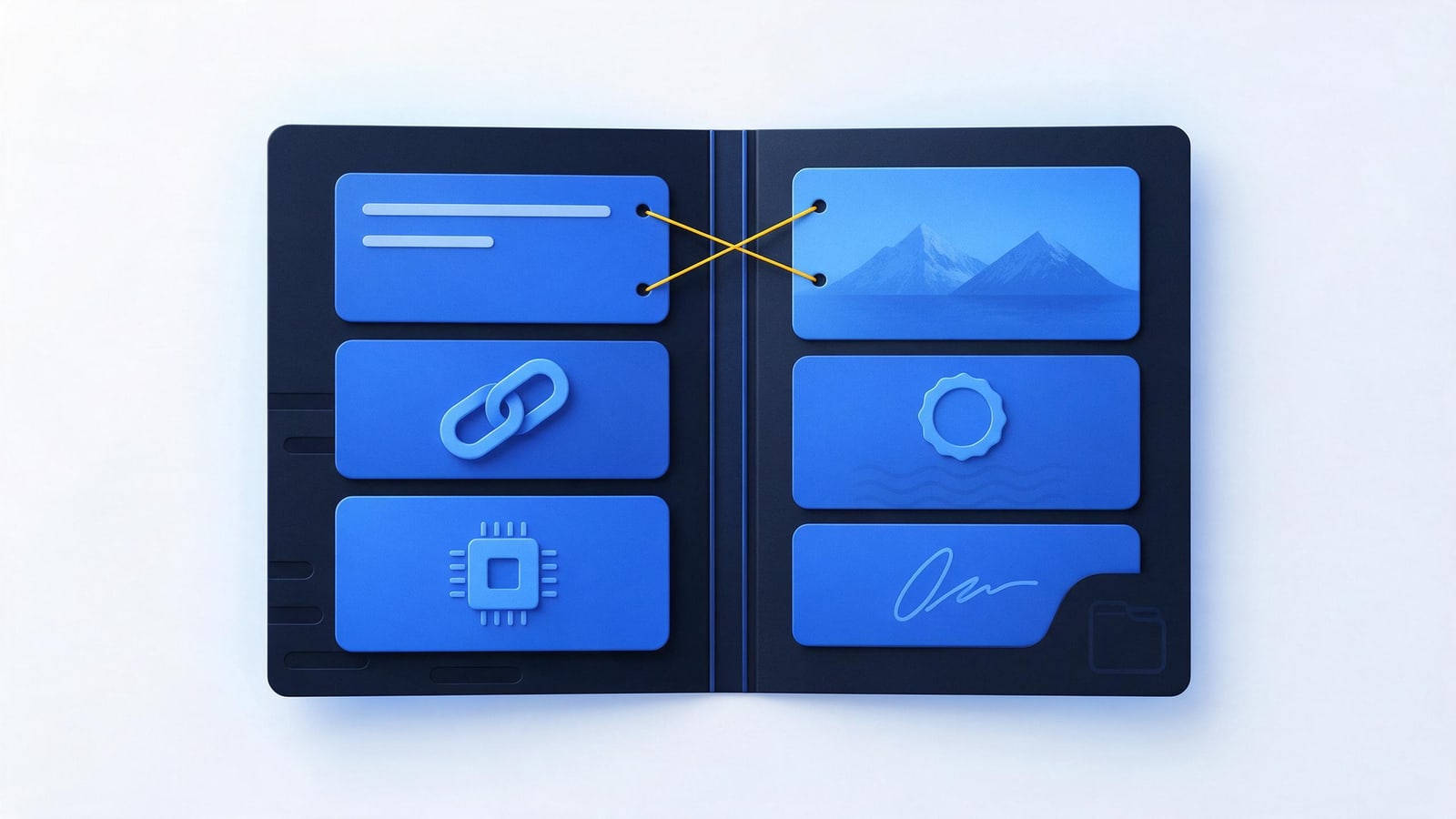
A takedown lives or dies on the evidence behind it. A complete pack has seven components: dated captures of the infringing page, the exact infringing URLs, your original work with its creation and publication history, metadata and file hashes tying the copy to that original, your registration status, a short comparison statement, and your contact details. When a notice stalls or comes back rejected, the cause is nearly always a gap in that list.
Order matters more than most people expect. Infringing pages get deleted, edited, or hidden behind a login within days, and once the live copy is gone, your best proof goes with it. Capture the copy first, secure your originals second, assemble the paperwork third. This checklist follows that sequence, then adapts the pack by medium and by channel.
The Evidence Pack Inventory: What Every Notice Needs
Under US law, 17 U.S.C. § 512(c)(3) sets out what a takedown notice must contain. Your evidence pack exists to back every element; our DMCA notice template explained walkthrough shows how the two line up. Seven items make the inventory:
- Infringement captures. Dated screenshots or recordings of the infringing material, exactly as you found it.
- Infringing URLs. One exact URL per infringing item, recorded the day you found it.
- Originals. Your work in its earliest form, plus proof of when it was created and published.
- Metadata and hashes. The technical fingerprints connecting the copy to your file.
- Registration status. A US Copyright Office registration number, or the date you applied.
- Comparison notes. A sentence or two per URL describing what was copied and where.
- Sender information. Your signature, contact details, and the statutory good-faith and accuracy statements.
Notice how the list pairs: captures match originals, URLs match comparison notes. A reviewer who can pair every URL with its original in under a minute acts fast. A reviewer forced to guess stalls the request, and stalled requests are how copies multiply.
Capture Order: Document the Infringement Before Anything Else
Do not contact the infringer yet. Do not file anything yet. The live page is the most perishable item in your case, and any contact, a comment, an email, a public callout, can make it vanish before you document it. Work in this order:
- Screenshot the page immediately, full length, with the address bar visible.
- Save a local copy, through print-to-PDF or a single-file save.
- Add the URL to a public web archive so a neutral third party can verify it later.
- Log the URL, the date, and the time, with your timezone noted.
- Only then move on to your originals and the paperwork.
While you capture, run a quick check against yourself. Confirm the use is not something you licensed or authorized, and not a fair use, a notice that knowingly and materially misrepresents infringement creates liability under § 512(f). Our guide on fair use and when not to file a DMCA takedown covers that call. A complete pack also shortens how long a DMCA takedown takes, because nothing bounces back asking for clarification. If you handle removals for clients, this fixed order keeps matters from bleeding together; see DMCA takedown for agencies for the volume workflow.
Screenshots and Archived Copies That Hold Up
A usable screenshot shows four things at once: the infringing material, the URL, the date, and the context. Get the address bar in frame, and use full-page capture for long pages. For video, a still frame is weak, record a short clip of playback instead. For marketplace listings, capture the price, seller name, and item ID along with it.
Context turns a picture into evidence. Capture the uploader's username, view counts, download buttons, and anything showing how the material is distributed or sold. If one account hosts several copies, capture the profile page too.
Then build redundancy. Save an archived copy through a public web archive so the page exists somewhere neutral, outside your control. Archives fail on pages behind logins, on dynamic players, and on content loaded inside frames, so treat your screenshots and local saves as the primary record and the archive link as corroboration. Keep a naming convention from the start, and one evidence log per infringer.
Infringing URLs: Exact, Complete, One Per Item
Every URL goes in the pack verbatim: full address, protocol included, all parameters and fragments intact. A truncated URL is the most common reason a host replies that it cannot locate the material. List one URL per infringing item, an entire website is not a location. If the same photo appears on a gallery page and as a direct download, list both.
Match the format to the channel. Hosts and marketplaces want URLs in plain text, one per line. If an address is long or garbled, keep the screenshot beside it and say so in your comparison notes. If the content sits behind a login, state that and describe what a reviewer will see after signing in.
Record the date you captured each URL, because pages move. When a site hides behind a privacy proxy or a CDN, finding the right recipient takes extra steps: a lookup to find out who owns the domain tells you who registered the site, and that detail belongs in your file even if the notice ultimately goes to the host.
Originals and Metadata: Proving the Work Was Yours First
The originals section answers one question: whether the work existed as yours before it appeared on their page. Pull the earliest version you have, the RAW photo, the multitrack session, the draft with tracked changes, the private repository. Then document creation and publication dates from sources that are hard to fake: camera metadata, upload receipts, document version history, emails containing the file, dated client invoices.
Metadata deserves special care with photographs. EXIF fields carry camera model, lens, capture timestamp, and sometimes GPS coordinates; our EXIF metadata as evidence guide covers what each field proves. Most social platforms strip EXIF on upload, so a stripped copy on their side proves little either way. What protects you is intact metadata on your original, preserved as it came off the camera. Never edit an original to clean it up, make working copies instead.
Timestamps are the backbone of the pack: your work existed first, the copy appeared later. Our timestamp evidence for copyright guide covers which timestamps carry weight and which are trivial to fake. For the full chain of proof, how to prove content ownership walks the sequence.
File Hashes: Fingerprints That Close the Match
A cryptographic hash is a short fingerprint computed from every byte in a file. Identical files produce identical hashes; change one pixel or one character and the value changes completely. Compute a SHA-256 hash of your original and, if the infringing copy is downloadable, of that copy too. Matching values show the two files are identical, byte for byte, the strongest match evidence you can attach to a notice.
Hashes shine for direct downloads: torrent payloads, shared-drive files, distributed code. They do less for re-encoded media. If someone re-uploads your video at a different resolution or rips your audio through a different encoder, the bits change and the hashes stop matching even though the copying is obvious. That is why comparison notes and timestamps sit alongside the technical match.
Most operating systems compute SHA-256 from the command line with no extra software. Record each hash in your log next to the file it came from, with the date you computed it.
Registration Status: What the Copyright Office Adds
A DMCA notice does not require a registered copyright, platforms remove material based on unregistered works every day. Registration changes what happens after the notice, and that difference is worth planning for while you assemble the pack.
US law generally bars a copyright owner from filing an infringement suit until the Copyright Office acts on a registration application, a rule the Supreme Court confirmed in 2019 in Fourth Estate v. Wall-Street.com. Statutory damages and attorney's fees require timely registration: before infringement began, or within three months of first publication. A registration issued within five years of publication is also prima facie evidence of validity in court.
None of that is needed for the takedown itself. All of it matters if a copy reappears or a counter-notice arrives, our guide to what happens after a counter-notice explains that fork. Whether copyright registration is worth it works through the cost-benefit. If escalation is plausible, file the application while the takedown is in flight; the Copyright Office offers expedited handling for a fee.
Evidence by Medium: Photos, Video, Music, Text, and Code
Each medium has one piece of evidence that carries the case. Know yours before you file.
Photos. The RAW file is the strongest item you can hold: its EXIF data ties the image to your camera. A watermark that survived cropping strengthens the match. Our DMCA for photographers resource covers the workflow, and the steps for getting pictures removed from a website show where this evidence lands in the notice.
Video. Camera originals and project files prove authorship; upload history proves publication. Capture the infringing playback as a recording, not a still. Expect hash mismatches on re-encodes, and build the comparison around unique edits or mistakes the copier reproduced.
Music. Stems and DAW session files establish creation; PRO registrations such as ASCAP or BMI, ISRC codes, and distribution records establish publication. Streaming rips re-encode audio, so treat hashes as a bonus. Our DMCA for musicians guide maps the sequence.
Text. Drafts, version history, and dated publication records establish priority. A plagiarism-scan report highlighting matching passages makes a reviewer's job simple, attach one if you have it. Authors will find the DMCA for authors walkthrough useful for manuscripts and serialized work.
Code. Commit history in a private repository is the closest thing software has to a notarized timeline. A license file shows the terms the copier violated; matching hashes show verbatim copying. GitHub runs its own process, our GitHub DMCA takedown guide covers it, and game studios should also read DMCA for game developers for build and asset evidence.
Tailoring the Pack to the Channel
The same evidence lands differently depending on where you send it. Match the pack to the recipient.
Hosts and abuse desks want the full statutory notice: clean URLs and a comparison a reviewer can verify in minutes. When a domain sits behind a CDN or proxy, identify the real host first, our find out who hosts a website walkthrough covers the lookup, and send the notice there.
Search engines do not remove content from the web; they delist URLs from results. A Google DMCA removal request needs the same ownership proof, but the harm you describe is discoverability. If a host ignores you, delisting is the cleanup layer.
Marketplaces such as Etsy and Shopify run their own forms and act quickly on listings when the pack is clean: listing URLs, your product photos as originals, and dates. Our Etsy and Shopify copyright infringement guide covers what those platforms request.
Social platforms trade in strikes and in-app reporting flows. YouTube pairs takedown notices with its own rights systems, our YouTube DMCA takedown guide covers the sequence. Expect account strikes and uploaders who re-post under new accounts.
Cross-border note: platforms with EU users also answer to Article 17 of the EU's Digital Single Market copyright directive, which requires best efforts to keep notified works from reappearing, a duty that can work in your favor, though with different notice formalities than a US notice.
Frequently Asked Questions
How many screenshots do I need for a takedown notice?
Enough to show the entire infringing item on each URL. One full-page capture per URL is the minimum; add close-ups of key details, the address bar, visible dates, and the uploader's name. For video or audio, record a short clip of playback. Pair every capture with its URL and date.
Do I need to register my copyright before sending a DMCA takedown?
No. Platforms act on DMCA notices for unregistered works every day. Registration matters later: US law generally bars an infringement suit until the Copyright Office acts on an application, and statutory damages and attorney's fees require timely registration. A counter-notice is where that gap bites.
What if the infringing page gets deleted while I'm collecting evidence?
Capture before you contact anyone. If a page vanishes anyway, check public web archives for an older copy and preserve what you already saved, with its dates. You can still report the URL to the host and to search engines if the copy resurfaces elsewhere.
Can one DMCA notice cover multiple URLs and multiple works?
Yes. Batch notices are common, and platforms expect them. Keep the mapping clean: identify each work once, then list every infringing URL beneath it. A reviewer forced to guess which original matches which URL will slow the request or reject what cannot be matched.
What happens if the infringer files a counter-notice?
The host must restore the material within ten to fourteen business days unless you file a court action against the uploader. That deadline is why evidence quality matters: a complete pack lets a lawyer move fast. Read the counter-notice carefully before escalating.
Your Next Steps
- Capture every infringing URL today: full screenshots, local saves, archive links, logged dates.
- Gather originals with creation and publication proof, and hash any downloadable copies.
- Check your registration status, and file an application if escalation is on the table.
- Confirm the use is unauthorized and not a fair-use case before filing.
- Pair each URL with an original and one comparison line, then file with the right recipient.
If you would rather handle the matter yourself, our DIY takedown guide walks through drafting and filing the notice. If the case spans dozens of URLs or a platform ignores the first notice, that is when a professional service earns its fee, WebDMCA files takedowns every day and can take your pack through the full escalation ladder.