
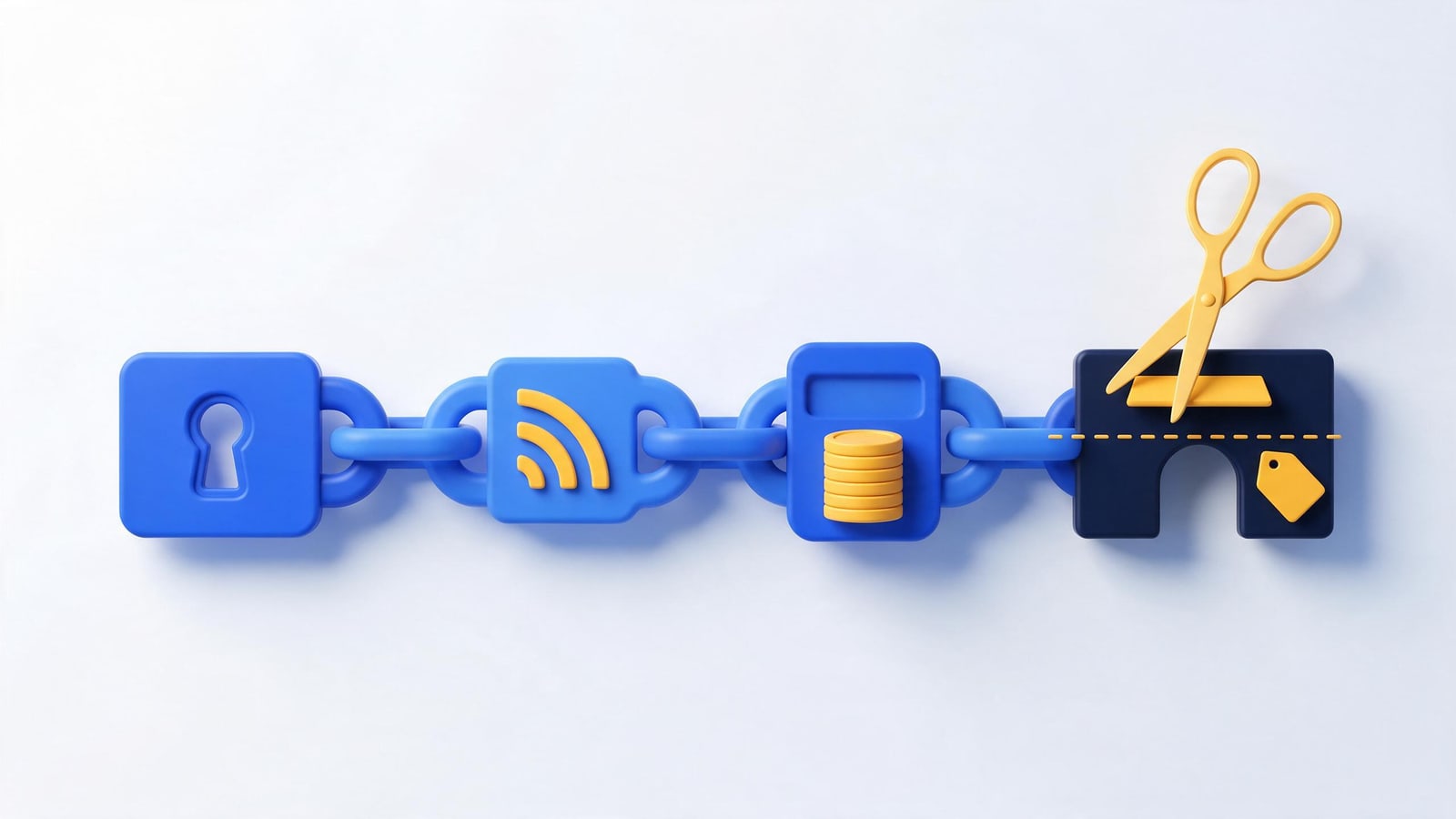
When your paid content shows up on a leak site, it feels like random cruelty. It isn't. The OnlyFans leak economy is a supply chain with four distinct roles, and leaks keep coming because the chain makes money at every stage. Almost none of that money comes from selling your content itself. It comes from the attention your content attracts, and attention has revenue lines, middlemen, and bills that can all be attacked.
If you found a leak today, start with what to do in the first hours after an OnlyFans leak. Then come back here, because the quick fixes only hold if you understand the machine you are fighting. Each role in this chain has a different pressure point, and the sections below walk through them in the order you would actually act.
The four roles in the leak supply chain
The collector is the only person who ever paid you. They subscribe, capture the content, and share it inside invitation-only trading circles, where a large archive buys status and access to other archives. Most public leaks are born here, two hands before they ever reach a website. The motive is usually reputation, not cash, which is why price changes and public complaints never slow this layer. The pressure point is the account: subscription platforms verify identity and payment, can often trace a leaked file back to the subscriber who accessed it, and terminate accounts under the repeat-infringer rules of 17 U.S.C. § 512(i), covered in our guide to the repeat-infringer policy. A collector with years of standing has something real to lose.
The poster repackages those files across leak forums, file lockers, and Telegram channels, trading uploads for reputation points, channel subscribers, and small crypto tips. This is the cheapest link to replace, so removing one post accomplishes little. Removing the channel is what costs the chain something, because followers and reputation do not transfer.
The site operator runs the leak site. This is where real money enters: display ads, premium memberships promising full archives and fast downloads, and donation addresses. The operator monetizes attention, not files, and their dependency list, from hosting and domain to ad accounts and payment rails, is the longest in the chain.
The reseller is the most business-like and most fragile link. They sell curated packs at pocket prices through storefronts and Telegram bots, competing with free by selling convenience: organized, searchable, no maze of dead links. A checkout means a payment rail and a public storefront, which makes someone selling your content cheap the easiest target in the entire economy.
Where the money behind leaked content actually enters
Here is the counterintuitive core of the leak economy: once content is free, almost nobody pays for the files. This is a traffic business wearing a content business's clothes. Operators convert visits into ad impressions, membership sign-ups, and tips; resellers sell convenience to the small fraction of visitors who would rather pay a few dollars than fight file lockers. Ad rates on pirate inventory run low, which pushes operators toward those premium tiers. Your content is the bait. Attention is the product.
That makes the revenue lines, not the files, the strategic targets. Ad income depends on ad networks tolerating pirate inventory, and a documented report to the network serving a site's ads can pull that income. Membership income depends on a payment rail, and the card networks hold acquiring banks responsible for merchants selling illegal or infringing content, so a documented report can trigger fines or termination. Crypto donations bypass the cards but convert poorly. You never have to destroy a revenue line permanently, you only need it to cost more than the site earns. Specialists who are good at following the money in piracy cases rarely argue with operators at all; they get the funding shut off.
Resellers are the direct-sales exception, and the same logic hits them harder. Their storefronts live or die by the checkout, and payment processor cutoffs have repeatedly ended pirate storefronts overnight. Capture the sale page, the checkout screen, and the processor's name before the store notices you looking.
Map your leak footprint before you act
Volume is not the goal; removing the right URLs is. Start by finding every copy: reverse image search on a few distinctive stills surfaces leak sites, Telegram channels, and forum threads faster than searching filenames ever will. For each hit, find out who actually hosts a website, because the host, not the operator, is who a notice reaches. Some leak sites only aggregate links to file lockers; there, the locker is the host that matters. Many sites sit behind Cloudflare; the proxy is not the host, but abuse reports to Cloudflare get forwarded to the server behind it.
If you want the operator's identity, who owns the domain is the first question, though privacy registrations often answer it with a shrug. Document everything before it moves, full URLs, dated screenshots, checkout pages, using a takedown evidence checklist. Sites get rebuilt. Your evidence file is what makes the rebuild expensive for them rather than for you.
Search delisting: cutting leak sites off from their traffic
Operators monetize attention, so the single highest-leverage move is killing their discovery. A notice to a host removes one copy. A DMCA removal request filed with Google removes that URL from the results delivering the traffic, and Google also applies a piracy demotion signal to domains that accumulate valid notices, sinking the whole site over time. Bing runs its own legal-removal form. A page nobody can find generates no impressions, no sign-ups, and no donations, which is why delisting hurts an operator more than any single file removal.
Two practical notes. Expect delisting and host removals to take days, not hours, so submit every mapped URL in the first batch instead of trickling notices. And Google forwards the copyright notices it processes to the Lumen Database, a public archive where your name and contact details are generally visible. For adult-content creators, filing through a registered agent or a professional service is standard practice for exactly that reason.
Channel-by-channel: where posters operate and what removes them
Posts do not travel alone; they travel through platforms, each with its own process. Telegram is the main distribution hub, and removing leaked files from Telegram through its designated agent works, report the channel and the bots that mirror it, since channels that accumulate valid complaints risk termination. Discord's DMCA process reaches server-hosted archives, and Reddit's DMCA process covers subreddit posts and profile uploads, with repeated notices leading to account suspensions.
Social feeds are the marketing layer. DMCA takedowns on Instagram and TikTok and X's copyright reporting form remove the posts and, with repeat strikes, the promotional accounts funneling followers to the leak site. Every channel removed cuts the operator's referral traffic and wipes out a poster's accumulated reputation, the exact asset they were paid in.
The DMCA machinery behind every move
Everything above runs on one chassis: how safe harbor works under the DMCA. Hosts, search engines, and platforms are shielded from copyright liability only if they remove material expeditiously after receiving a notice that satisfies 17 U.S.C. § 512(c), it identifies your work, identifies the infringing URL, gives your contact details, and states under penalty of perjury that you have a good-faith belief the use is unauthorized. Knowing how to prove you own the content is what separates notices that get acted on from notices that get bounced.
Know the counterweights. If a poster files a counter-notice under § 512(g), the host can restore the material after 10 to 14 business days unless you file a court action, so read what happens after a counter notice before assuming any removal is permanent. Knowingly false claims carry penalties under § 512(f). For identifying the infringer, the 512(h) subpoena can compel a provider to name an account, though courts have limited its use against services that merely store user content. And when the host is offshore and ignores US notices, how DMCA works internationally has real limits, that is when delisting, payments, and platform pressure carry the weight.
One lever changes the math for resellers: registration. A US copyright registration, ideally filed within three months of first publication under 17 U.S.C. § 412, makes statutory damages up to $150,000 per work for willful infringement and attorney's fees available in court. Whether copyright registration is worth it for a creator's backlog is usually a quick yes for the best-performing sets. This is general information about the law, not legal advice, but it is the framework any copyright attorney would start from.
When leaked content is also intimate imagery
Explicit leaks are copyright problems and something more. Content you made consensually for paying subscribers becomes nonconsensual intimate imagery the moment it is redistributed, and that opens a second, faster track. The Take It Down Act, signed into law in 2025, criminalizes publishing nonconsensual intimate images, including AI-generated fakes, and requires covered platforms to remove reported images within 48 hours. Free services like StopNCII create hashes of your images so participating platforms block re-uploads on arrival; that is how content fingerprinting works, applied to protection.
In practice, file both tracks at once. NCII removal routes do not require proving copyright ownership, they move faster than most hosts, and deepfake removal covers fabricated versions of you that never existed as content at all. Copyright gets the page down; the intimate-imagery track keeps major platforms from letting it back up.
OnlyFans leak economy: frequently asked questions
Who actually profits when my OnlyFans content is leaked?
Rarely the person who leaked it. Collectors are paid in status inside trading circles; posters trade uploads for reputation. The money concentrates in two places: the operator, who converts traffic into ad revenue, memberships, and donations, and the reseller, who sells convenience a few dollars at a time. Your content is the bait; attention is the product.
Can I send a DMCA notice without registering my copyright?
Yes. Copyright exists the moment you create the work, and a 17 U.S.C. § 512(c) notice requires no registration. Registration matters for what comes after: statutory damages and attorney's fees are generally available only if you registered before the infringement began or within three months of first publication. For creators with popular back catalogs, registering the best-performing sets is cheap leverage against resellers.
Can I find out which subscriber leaked my content?
Sometimes. Subscription platforms log which account accessed which content, and forensic watermarks can tie a leaked file to a specific subscriber, so a report to the platform can end the responsible account. Beyond the platform, a 512(h) subpoena can identify an infringer, though courts have narrowed its use against hosting providers. Resellers frequently identify themselves through their storefronts and payment pages.
Do takedowns work if the leak site is hosted offshore?
Against the host, often not, US law does not bind an offshore server. But the chain still runs through reachable chokepoints: Google and Bing delist the URLs, card networks cut memberships and storefront sales, and the channels feeding the site sit on platforms with US offices. Offshore sites survive hosting. They struggle to survive losing discovery and revenue.
Will the same content just get reposted after removal?
Reposts are likely, because demand persists after any single site dies, but reposts have a cost curve. A leak removed before it ranks never collects backlinks or mirror channels. Some hosts restore content after a counter-notice window of 10 to 14 business days. Treat enforcement as ongoing: detection on arrival, removal before ranking, and hash-based blocking make each cycle cheaper than the last.
What to do this week
The chain re-forms because demand never disappears with a site. What wins is repetition that gets cheaper every cycle while the operator's rebuild cost stays constant. Enforcement is a subscription, not an event.
- Save evidence now: full URLs, dated screenshots, reseller checkout pages.
- Send § 512(c) notices to every host on your map, plus delisting requests to Google and Bing.
- If the content is intimate, file NCII reports in parallel, the Take It Down Act track moves fastest.
- Report reseller storefronts to their payment processors, with the checkout evidence attached.
- File against the distribution channels: Telegram, Discord, Reddit, and the social accounts promoting the leak.
- Register your best-performing content sets if you have not.
- Put ongoing creator protection monitoring in place; per-URL pricing makes continuous enforcement cheaper than one panic cleanup.